Tamil Nadu, a land full of ancient history, is the birthplace of some of India’s greatest assets. With records dating back to the 5th century BCE, this region has seen the rise of powerful kingdoms that not only shaped the Indian subcontinent but also extended their influence far beyond its shores. The Tamil kings Cheras, Cholas, and Pandyas established maritime dominance, conquering parts of Southeast Asia and leaving a lasting impact on regions like Sri Lanka, Indonesia, and Cambodia.
Their architectural marvels, rich literature, and traditions stand as a witness to the lives they lived. Tamil, one of the oldest living languages in the world, with a history spanning over 10,000 years, has been the carrier of this magnificent heritage.
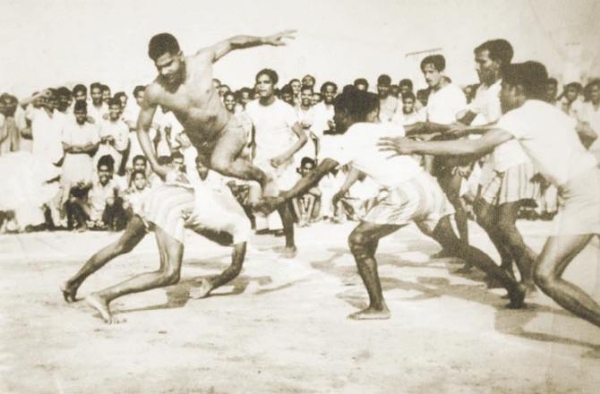
While Tamil Nadu is home to many age-old traditions, one of its most celebrated sports is kabaddi. The game, which has now gained international recognition, has been played in the villages of Tamil Nadu for thousands of years.
Some historians trace its origins to the Vedic period (1500 BCE – 500 BCE), and it is believed to have been inspired by Jallikattu, the famous bull-taming sport played during Pongal. The essence of kabaddi is similar to it; one player enters the opponent’s side and is treated like a bull, attempting to evade capture while tagging opponents.
Kabaddi in Tamil Nadu is a way of life. In almost every festival or village fair (mela), kabaddi tournaments are held with passionate players competing for pride and honour. Each village has its kabaddi team, with intense rivalries emerging as they battle for dominance. The sport represents discipline, strength, and teamwork, making it one of the most honoured sports in the state.
The Evolution of Kabaddi
It started as a traditional sport played on clay courts in the villages and has now made its way to the international stage. Kabaddi gained formal recognition when it was included in the Olympic Games, not formally, but it gave a much-needed recognition to the sport. The sport’s rise continued, finding a place in the 1951 and the 1990 Beijing Asian Games, the Asian Indoor Games, and the Asian Beach Games.
In 1936, a 35-member team from Hanuman Vyayam Prasarak Mandal (HVPM), a lesser-known physical education institute in Amravati, Maharashtra, was invited to Berlin to demonstrate various indigenous sports, including a traditional form of kabaddi known as hu tu tu. This opportunity was made possible largely due to the efforts of HVPM’s vice-president at the time, Dr Siddhanath Kane, who played an important role in securing the invitation. Decades later, the establishment of the International Kabaddi Federation (IKF) in 2004 further strengthened the sport’s global presence, aiming to elevate kabaddi to Olympic status and expand its reach worldwide.
Three men’s kabaddi World Cups have been held since 2004, 2007 and 2016, with the Indian kabaddi team winning gold medals in all three and Iran finishing runners-up at each tournament.
However, the real turning point came in 2014 when the Pro Kabaddi League (PKL) was launched. The league transformed the sport, bringing it to television and introducing a new wave of popularity. The PKL showcased kabaddi as a high-energy, action-packed sport, drawing millions of viewers and creating a new generation of fans. Today, kabaddi has leagues in multiple countries, and international teams compete in world tournaments, proving that this once-rural sport has achieved global recognition.
Kabaddi may have spread worldwide, but India remains the undefeated powerhouse of the sport. The Indian national team has dominated international kabaddi tournaments, winning multiple gold medals in the Asian Games and the Kabaddi World Cup.
In 2023, India defeated Iran 33-29 in the final to win the gold medal in Hangzhou, China. The Indian team also secured gold medals in 2014 and 2010. In the women’s category, India achieved victory in 2023 and now in 2025 as well.
The men’s and women’s teams have consistently outperformed their rivals, showcasing superior skill, agility, and excellence. The strength of Indian kabaddi shoots up from its deep-rooted connection to rural India, where players develop their craft from a young age, blending physical endurance.
Countries such as Iran, South Korea, and Bangladesh have emerged as strong contenders in recent years, but India continues to set the benchmark for excellence in the sport. The rise of kabaddi as an international game has only strengthened India’s position as the sport’s global leader.
Despite the evolution, kabaddi has preserved its core principles. Traditionally played on a clay court in rural Tamil Nadu, it has now transitioned to synthetic mats for professional tournaments. Each team consists of 12 players, with seven on the court and five in reserve. The objective is simple yet thrilling: one player (the raider) enters the opposing side, touches as many defenders as possible, and returns safely to their side while chanting “kabaddi, kabaddi” without taking a breath. The defenders, in turn, attempt to tackle and hold down the raider to prevent them from scoring.
Kabaddi represents the cultural roots that the people of Tamil Nadu and India have embodied for centuries. It reflects the warrior-like spirit of the ancient Tamils, who defended their land and conquered new territories with determination and skill. Today, as kabaddi reaches new heights on the global stage, it carries with it the legacy of Tamil Nadu, a land where tradition and modernity coexist seamlessly.
From the historic Keeladi excavations to the global success of kabaddi, Tamil Nadu has always been at the forefront of cultural and sporting excellence. The state continues to preserve its rich heritage while pushing forward into new arenas, proving that its legacy is far from over. As kabaddi thrives worldwide, it remains a proud reminder of Tamil Nadu’s deep-rooted history, solid passion, and an everlasting spirit.