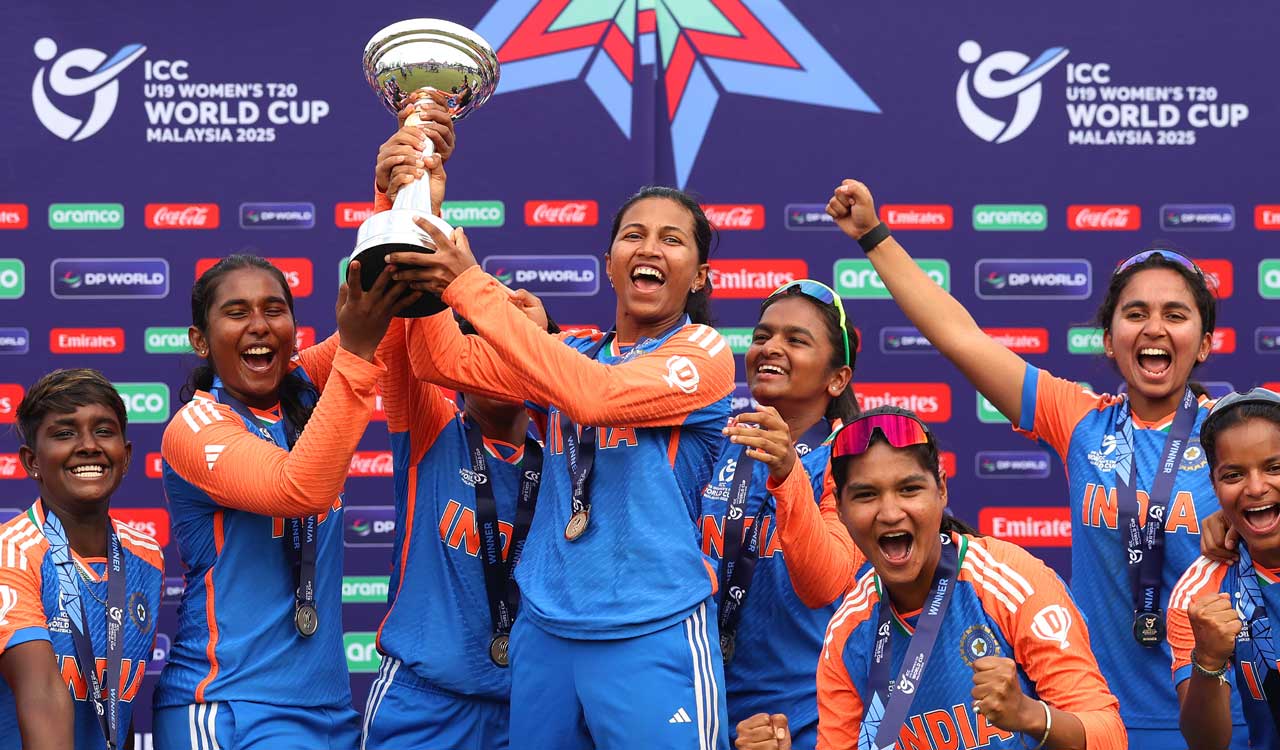
The Indian blind women’s cricket team has pulled off a massive moment for the country right after winning the ODI Women’s World Cup.
Winning the inaugural Women’s T20 Blind World Cup after a solid win over Nepal in Colombo. Playing at the P Sara Oval, India held Nepal to 114/5 and then chased it down comfortably in 12.1 overs, losing only three wickets on the way to the title.
This is the first time a Women’s T20 World Cup has been organised for blind cricket, even though the sport itself has been around for more than a century. It began in 1922 in Melbourne, when two blind factory workers created a version of the game using a tin can filled with stones. Since then, blind cricket has slowly taken shape, eventually coming under the World Blind Cricket Council (WBCC), which was formed in New Delhi in 1996. Today, the council has ten member nations, including India, Pakistan, Australia, South Africa, Sri Lanka, England, and Nepal.
“Congratulations to the Indian team for winning the first-ever Blind Women’s T20 World Cup, an event that re-defines the limits of ‘ability’ and inspires differently abled athletes in India and around the world.” Jay Shah on X
While the men’s game has had several major tournaments, India has already won the men’s T20 World Cup in 2012, 2017 and 2022, and the ODI title in 2014, the women have never had a world event until now. For years, they played bilateral series and small invitational tournaments with no global stage to compete on. This World Cup was the first of its kind, and India made the most of it.
Blind cricket has its own set of rules: each team fields 11 players with a required mix of fully blind (B1), partially blind (B2) and partially sighted (B3) athletes. The stumps are made of metal tubes painted in bright colours, so partially sighted players can spot them and B1 players can orient themselves by touch. These rules, spread across 25 clauses, were officially approved in 2005 and are used worldwide.
This inaugural edition was co-hosted by India and Sri Lanka, with matches held in Delhi, Bengaluru and Colombo. Through the tournament, India looked settled and sure of their plans, and by the time they reached the final, they had the momentum firmly on their side.
The chase in the final summed up their campaign, calm and clear. And when the final runs were scored, it became the first step for women’s blind cricket on the world stage, and India now has its name on the very first chapter of the book.